Home › Guides › How to Build a Cheese Board
How to Build a Cheese Board That Actually Gets Eaten
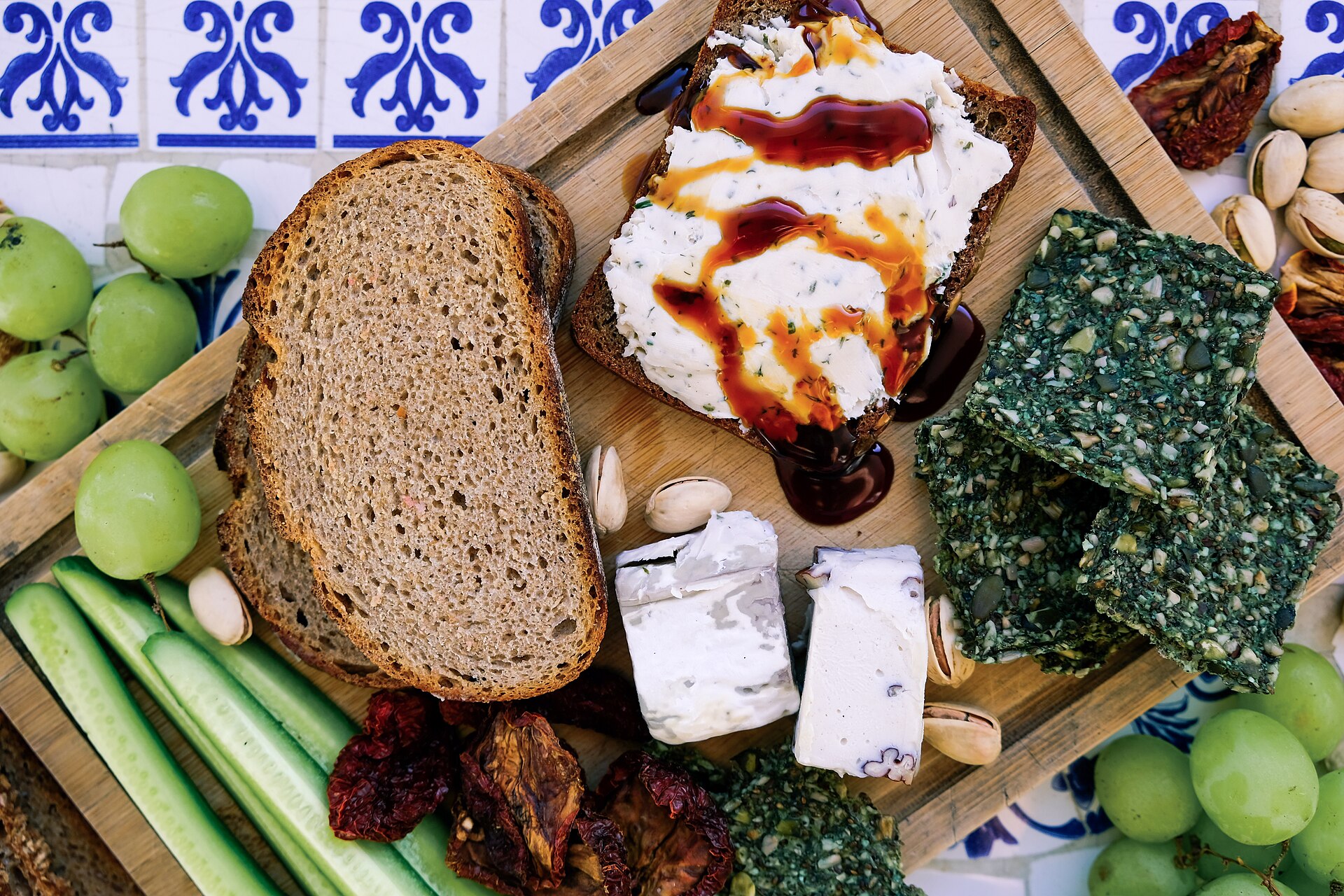
Most cheese board advice is arrangement porn: swoops of salami, artfully scattered almonds, a sprig of something. It looks great and it solves the wrong problem. A board fails when it runs out of the two cheeses people wanted and sits on a pound of the third wheel nobody touched. This guide fixes the actual problem — what to buy, how much, in what order to arrange it, and when to put it out.
Start with structure, not decoration: the 5-3-2 rule
Every good board I've built or eaten follows the same skeleton: five textures, three intensities, two anchors. It's a selection rule before it's an arrangement rule.
- Five textures: hard-crumbly (aged Gouda, Parmesan), firm (Manchego, cheddar), soft-ripened (brie, camembert), fresh (chèvre, burrata), and blue. Texture is what makes a board feel complete before anyone takes a second bite.
- Three intensities: mild, medium, aggressive. Guests self-sort — the Stilton people will find the Stilton. Give every palate a runway.
- Two anchors: the two cheeses you'd defend in an argument. Everything else is supporting cast. If you can't name your anchors, you're buying decoration.
For the matches, run each cheese through the cheese pairing generator — it gives accompaniments and pours with the reasoning, so you can swap intelligently when the store is out of fig jam.
How many cheeses, and how big a board
Two rules of thumb answer sizing before you ever look at a platter. First: about one cheese per two to three guests, capped at seven or eight — past that, every plate turns into a muddle and nobody can describe what they ate. Second: fewer, larger cuts beat more, smaller ones. The board should hold display wedges of your anchors plus cut pieces to eat from, not a mosaic of crumbs.
| Guests | Cheeses | Board | Working setup |
|---|---|---|---|
| 2-4 | 3 | 10-12 in round | One board, one knife; skip the second soft wheel. |
| 5-8 | 4-5 | 13-15 in round | Two anchors plus one wildcard; pre-cut two-thirds. |
| 9-15 | 5-6 | 18 in+ rectangle, or two 12-in boards | Split the anchors across both boards so each can be circled. |
| 16+ | 6-8 | Three boards, or a table station | Theme the stations — soft + fruit, hard + meat, blue + sweet — and rotate refills. |
Pick the board after the food, not before: lay the cheese out on the counter first, then choose the platter that fits it with an inch of working room for the knife. A board that starts three-quarters full overflows by hour two, right when people start cutting in.
Quantity math (the part everyone gets wrong)
The standard "2 ounces per person" is fine as a starting point and wrong as a plan, because it hides two variables: what's happening before and after the board, and how long the board needs to last. The full breakdown lives in our cheese board quantities guide, but the working version:
- Before dinner: 2 oz of cheese per guest, total, across all cheeses. No second helpings budgeted.
- Board as the meal: 4 oz per guest, weighted toward the meats and breads that plate higher.
- Long grazing party: 3 oz per guest for the first two hours, plus about half an ounce per guest per additional hour.
The fastest fix for "how much of each": the charcuterie board builder turns guest count into ounces per item, including the extras people forget to budget.
Arrangement order (do this, in this order)
Arrangement is 20% aesthetics and 80% traffic engineering. The order that works:
- Anchor the two statement cheeses at opposite ends of the board — usually the blue and the soft wheel. This splits the crowd instead of stacking it at one corner.
- Place pre-cut cheese, not whole wedges. People take three times more from a pile of cut pieces than from a wedge with knives — nobody wants to be first to cut into a beautiful wedge. Pre-cut two-thirds of each cheese; let the rind side stay intact for looks.
- Fill structural gaps with the tall and the piled: a jar of cornichons, a stack of crackers, a bowl of olives. Height first, scatter later.
- Fan the meats in, not on, the board's empty thirds — salami folds and prosciutto ribbons go in the gaps between cheeses, not around the rim where they slide off.
- Scatter fruit and nuts last, into whatever gaps remain. Grapes belong in tight connected bunches (loose grapes roll); nuts go in a shallow bowl or a corner pocket, not loose.
- Two knives minimum, one per soft cheese, and none shared between the blue and anything else — blue's mold migrates and mild-cheese people notice.
Timing: the 45-minute rule and the 90-minute window
Cheese served fridge-cold is aromatically mute — the fat is too firm to volatilize flavor. Pull the board cheeses out 45 minutes before serving; soft wheels want the full 45, hard cheeses 30 is plenty. During that window, cut what needs cutting, and cover loosely with a dry towel to keep the rind from drying.
The serving window is 90 minutes. After that, soft cheeses slump, cut surfaces sweat and case harden, and the board becomes a shelf. If your party runs long, hold a second board in the fridge — assemble it during the first hour and swap it in at the 90-minute mark: comfortably inside the two-hour limit that USDA food-safety guidance puts on perishables at room temperature. The swap creates a second "ooh" moment, which is half the reason boards work socially.
The T-minus timeline
Board-building schedules badly, so run it backwards from serving time:
- T-2 days: shop. The timing-sensitive purchase is the soft-ripened wheel — buy one with the most shelf life left and keep it cold until the morning of.
- T-3 hours: cut the hard cheeses. They hold up best and are the slowest to slump; rewrap the uncut portion in wax paper.
- T-45 minutes: everything comes out of the fridge, loosely covered with a dry towel.
- T-20 minutes: arrange — anchors first, structural gaps second, fruit and nuts last (the order from the arrangement section above).
- T-0: cut the soft wheels and add anything that wilts — torn basil, sliced apple. It never looks better than it does right now, so if you are photographing the board, photograph it now.
Five mistakes that quietly ruin boards
- Everything mild. Four polite cheeses means nothing anchors the board and everyone eats crackers. One blue or washed-rind cheese gives the mild cheeses context.
- Fruit as decoration only. Grapes and sliced apples are palate resets between rich bites; if they're too pretty to eat, the board stalls halfway. Cut fruit that needs cutting.
- Pre-shredded or pre-sliced "board cheese." Pre-shredded is dusted with anti-caking starch that tastes like the bag. Slice from real wedges — even ten minutes of knife work outperforms a bag.
- Cold board, warm room. A stone or slate board at 60°F pulls temperature out of the cheese. Use wood or room-temp slate, and keep the board away from the oven and direct sun.
- No label, no story. People eat more of what they can name. Small paper flags with the cheese names — and a one-word cue like "smoky" or "sharp" — reliably double consumption of the flagged cheese.
What to read next
- Cheese board quantities — full ounces-per-guest tables by party type and length.
- Cheese pairing generator — matches for each cheese you're considering.
- Charcuterie board builder — the same math, automated, with a shopping list.
- Wine & cheese, decoded — what to pour alongside it all.
Reference notes: USDA cold-food storage charts · UW–Madison Center for Dairy Research.
Learned on the ground: Wisconsin cheese counters, too many dinner parties, and one regrettable incident involving an entire unset brie. Written by Laura Chen for PairingPlates.